
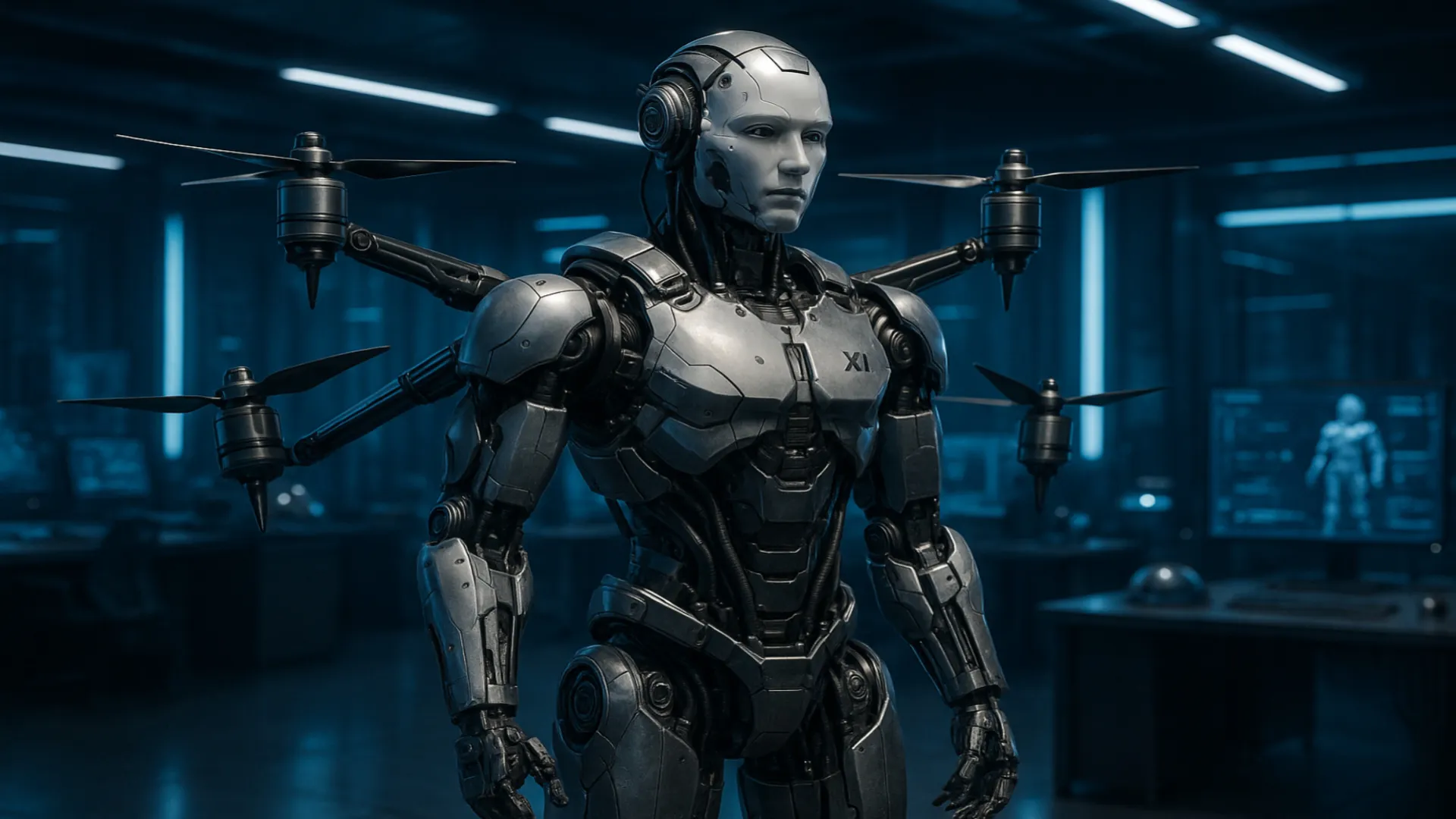
In the last few years, robotics has grown faster than anyone expected. From simple machines to highly intelligent humanoids, the technology world is moving into a new phase. But what happened recently has surprised even the most advanced researchers. A new robot called X1, created through a collaboration between scientists at Caltech and a major Chinese tech company, has become one of the most talked-about innovations of 2025.
Unlike traditional robots that can either walk or fly, the X1 can do both—and a lot more. It can walk like a human, roll like a ball, balance itself on rough surfaces, and then suddenly take off into the air like a drone. This unique combination of movements makes it one of the most versatile robots ever created. The development of X1 hints at a future where robots will not be limited to one function, but will be able to adapt themselves in real time just like humans do.
A Closer Look at the X1 Robot
The X1 robot isn’t just a machine with legs and propellers. It is built with a very lightweight frame, advanced sensors, and intelligent stabilization systems. What makes it particularly interesting is its ability to switch modes without any manual control. The robot analyzes its surroundings, decides what mode is best for the situation, and then moves accordingly.
For example, on flat ground, it behaves just like a regular humanoid—walking smoothly and maintaining balance. But if it faces a blocked path, uneven surface, or a place where walking is not possible, it can instantly transform into flying mode. This quick adaptability makes it useful for many types of real-world situations where traditional robots usually fail.
The design team has used carbon fiber and high-efficiency motors to keep the robot light but strong. This gives the robot more flight time, more stability, and better performance during long operations.
Why This Robot Is Considered a Breakthrough
The robotics community is calling X1 a “breakthrough innovation” because it breaks the usual rule that robots are built for one specific function. For decades, engineers have created separate categories—walking robots, drone robots, rolling robots, industrial robotic arms—but X1 combines all these abilities.
This means the X1 isn’t just a new robot. It represents a new idea:
A single robot should be able to move like a human… and like a machine… whenever needed.
This is exactly why many tech analysts believe that robots like X1 will change:
- How rescue missions are performed
- How deliveries are made
- How soldiers are protected
- How maintenance work is done in dangerous locations
- How space research is conducted
In short, this robot is not just a scientific achievement—it is the beginning of a new age in robotics.
Real-World Uses That Could Become Common Soon
Although the X1 robot is currently in testing, there are many areas where it can be used in the near future. Some of the most practical applications include:
1. Search and Rescue
After earthquakes, fires, or floods, rescuers often face dangerous conditions. A robot that can walk inside collapsed buildings and then fly over debris can save lives faster. Since X1 can roll, fly, and walk, rescue teams can send it anywhere without worrying about terrain.
2. Delivery of Medical Supplies
Many rural or disaster-affected areas become difficult to reach. The flying mode helps X1 deliver medicines, food packets, and emergency equipment quickly without needing roads or human pilots.
3. Military Surveillance
Modern armies depend heavily on surveillance. A robot that can quietly fly over an area and then land to walk like a human gives more control and flexibility. The robot can collect information, scan surroundings, and send live updates.
4. Industrial Inspections
Factories, power plants, oil pipelines, and high-risk areas need regular inspections. Sending humans increases risk. X1 can fly to high points, walk on narrow metal beams, and roll under heavy machinery—making inspections safer and faster.
5. Space Exploration
NASA and other space agencies are experimenting with robotic explorers. A robot that can both walk on surfaces and fly in low-gravity environments could help in lunar or Martian missions. It may become a part of future space exploration teams.
The Technology Behind the Movement
X1’s movements are not random. They are controlled by several layers of advanced AI and engineering:
- AI Navigation System
It reads the environment and calculates the safest movement mode—walking, flying, or rolling. - High-precision Sensors
These help the robot detect obstacles, cracks, unstable surfaces, and dangerous edges. - Dynamic Stability Controls
This system ensures that the robot does not fall, even when it slips or lands after flying. - Self-balancing Legs
Inspired by human muscle movement, the legs can shift weight instantly to maintain posture. - Rotor-Based Flight
The flight system works like a drone but with better control and shock-absorbing landing functions.
Together, these features allow X1 to move smoothly in places where traditional robots cannot function.
Why the USA Tech Community Is Watching Closely
American researchers and robotics companies see X1 as a strong sign that the next big leap in robotics has already started. For decades, the U.S. has led the world in robot development—from Boston Dynamics’ Atlas to NASA’s robotic explorers.
But the arrival of a hybrid robot like X1 shows that global collaboration is creating new possibilities. Tech universities in the USA are now studying how this robot can inspire next-generation designs. AI companies are also exploring how intelligent robots can be trained to work more independently in complex environments.
Some U.S. companies are even planning to develop their own hybrid robots for defense, logistics, and commercial use.
Is This the Beginning of Human-Like Robots?
The X1 robot is not a fully human-like robot yet, but it definitely takes a major step in that direction. It can:
- Understand surroundings
- Choose its own movement mode
- Maintain balance
- Fly independently
- Perform tasks that humans do
These abilities make it very close to what people imagine when they think of future robotics.
Experts believe that in the next 5–10 years, robots like X1 may become common in:
- Homes
- Hospitals
- Warehouses
- Offices
- Public service departments
- Construction sites
Robots may soon become companions, helpers, and frontline workers in areas where humans cannot go safely.
What Challenges Still Exist?
Even though X1 is a powerful innovation, it still faces some challenges:
- Battery life limits flying duration
- High development and manufacturing cost
- Security concerns during military or surveillance usage
- Ethical questions about replacing human workers
- Regulatory approval for flying robots in public areas
Researchers are confident that these challenges will be solved as technology improves.
The X1 hybrid robot is a major milestone in modern robotics. With its unique ability to walk, roll, and fly, it introduces a new era of multi-functional machines. It shows what the future of automation might look like—smart, flexible, and capable of performing tasks that were once impossible.
If development continues at this pace, robots like X1 could soon become a normal part of our daily life. From saving lives during disasters to helping astronauts on distant planets, this new generation of robots has the potential to change the world.